Experimental Equipment Product List and Ranking from 15 Manufacturers, Suppliers and Companies | IPROS

Last Updated: Aggregation Period:May 27, 2026~Jun 23, 2026
This ranking is based on the number of page views on our site.

Experimental Equipment Manufacturer, Suppliers and Company Rankings

Last Updated: Aggregation Period:May 27, 2026~Jun 23, 2026
This ranking is based on the number of page views on our site.

  1. メガケム Kanagawa//Educational and Research Institutions
  2. SETO ENGINEERING 守谷事業所 Ibaraki//Building materials, supplies and fixtures manufacturers
  3. 島谷技研 Osaka//others
  4. 4 シマテック Saitama//Facility Design Office
  5. 5 長野オートメーション Nagano//others

Experimental Equipment Product ranking

Last Updated: Aggregation Period:May 27, 2026~Jun 23, 2026
This ranking is based on the number of page views on our site.

  1. TD360 Heat Exchange Experiment Device メガケム
  2. Low-budget, space-saving tabletop roll-to-roll experimental machine. SETO ENGINEERING 守谷事業所
  3. Smoke wind tunnel experimental device メガケム
  4. 4 Shimatani Giken Co., Ltd. Company Profile 島谷技研
  5. 5 Series and parallel vortex pump experimental apparatus メガケム

Experimental Equipment Product List

1~30 item / All 82 items

Displayed results

Lithium-ion electrolyte injection experiment device for small batteries

Lithium-ion electrolyte injection experiment device for small batteries

We design and manufacture various production equipment and experimental devices for lithium-ion (Li-ion) and nickel-metal hydride (Ni-MH) batteries. We accommodate cylindrical, rectangular, and laminated types. Depending on the process, we have demo and experimental machines available, so please feel free to contact us.

  • others
  • Other analytical equipment
  • Experimental Equipment

Added to bookmarks

Bookmarks list

Bookmark has been removed

Bookmarks list

You can't add any more bookmarks

By registering as a member, you can increase the number of bookmarks you can save and organize them with labels.

Free membership registration

Control experiment solutions for education and research.

For over 30 years, Quanser has specialized in the development of systems and solutions for cutting-edge education and research in control.

Quanser's experimental teaching materials are ready to use as soon as they are taken out of the box. The systems feature an open architecture and modular design, allowing for a wide range of mechatronic experimental configurations due to the commonality of the base unit and peripheral devices across each system. Additionally, by adding or removing various modules, you can expand the functionality of the invested laboratory equipment. Even more importantly, it enables students to create a diverse range of challenges that they should explore. Furthermore, Quanser's comprehensive lineup of mechatronics and control experiments is robust enough to meet the demands of enthusiastic and motivated students.

  • others
  • Experimental Equipment

Added to bookmarks

Bookmarks list

Bookmark has been removed

Bookmarks list

You can't add any more bookmarks

By registering as a member, you can increase the number of bookmarks you can save and organize them with labels.

Free membership registration

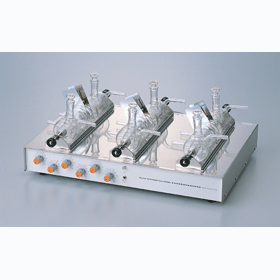
Membrane Permeation Experimental Device PERMCELL

Under various experimental conditions, the net membrane permeability of drugs and toxins can be measured.

The liquid inside each cell was completely mixed by the rotation of the stirrer. The thickness of the stagnant boundary layer formed on the membrane surface has been clarified under various stirring conditions, allowing for the determination of the net membrane permeation rate. The stirring drive device is a magnetic stirrer capable of continuous operation for long periods, which can simultaneously operate three sets of PERMCELL and can vary the stirring rotation speed over a wide range (approximately 500 rpm to 2000 rpm) depending on the type of membrane. There are two types of membrane mounting parts: one for flat membranes and one for spherical membranes, and in addition to the closed-type sample port stopper, a flow-type stopper is also available.

  • others
  • Experimental Equipment

Added to bookmarks

Bookmarks list

Bookmark has been removed

Bookmarks list

You can't add any more bookmarks

By registering as a member, you can increase the number of bookmarks you can save and organize them with labels.

Free membership registration

Low-budget, space-saving tabletop roll-to-roll experimental machine.

We have achieved a compact roll-to-roll device in a size of 1.3m × 0.8m, which was previously only possible with large-scale equipment! It enables a wide variety of processing.

We would like to introduce our "Tabletop Roll-to-Roll Experimental Machine." With a compact design, it can be installed on laboratory workbenches or in draft chambers, and we can offer it at a low price due to a minimal equipment configuration. Thanks to the roll-to-roll processing technology we have developed over the years, the processing unit can accommodate a wide variety of treatments. Additionally, by swapping out the processing units, it can support various types of processing. We have a proven track record in the battery and 5G industries. 【Features】 - Compact design allows installation on laboratory workbenches or in draft chambers - Low-cost proposals possible due to minimal equipment configuration - A wide variety of treatments can be performed by exchanging processing units *For more details, please refer to the PDF document or feel free to contact us.

  • others
  • Experimental Equipment

Added to bookmarks

Bookmarks list

Bookmark has been removed

Bookmarks list

You can't add any more bookmarks

By registering as a member, you can increase the number of bookmarks you can save and organize them with labels.

Free membership registration

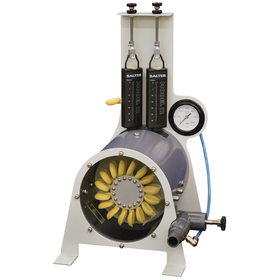
Spiral pump experimental device

Spiral Pump Experimental Device

This is a device for extensively experimenting with the operational characteristics of a centrifugal pump. It operates a pump with an internal observation capability using a variable speed motor, drawing water from a tank and circulating it back to the tank through a strainer, valve, and venturi tube. The impeller section is designed with a transparent cover for observation. The pump's rotational speed (rev/min), torque (N.m), output (W), differential pressure in the venturi tube (△P), and inlet and outlet pressures of the pump are digitally displayed, allowing for a wide range of experiments by changing operating conditions through valve adjustments. Additionally, by utilizing the optional data automatic collection system VDAS (sold separately), various data can be collected and analyzed in real-time on a PC (sold separately).

  • Analysis and prediction system
  • Experimental Equipment

Added to bookmarks

Bookmarks list

Bookmark has been removed

Bookmarks list

You can't add any more bookmarks

By registering as a member, you can increase the number of bookmarks you can save and organize them with labels.

Free membership registration

Series and parallel vortex pump experimental apparatus

Series and parallel vortex pump experimental apparatus

This is a device used to experiment and research the operating characteristics of one or two spiral pumps (connected in series or parallel) over a wide range. Two variable-speed motors operate each pump, which can be observed internally, drawing water from a tank and circulating it back to the tank through a strainer, valve, and venturi tube. The impeller section is designed with a transparent cover for observation. The pump's rotational speed (rev/min), torque (N.m), output (W), pressure differential in the venturi tube (△P), and inlet/outlet pressure of the pump are digitally displayed, allowing for a wide range of experiments by changing operating conditions through valve adjustments. Additionally, by utilizing the optional data automatic collection system VDAS (sold separately), various data can be collected and analyzed in real-time on a PC (sold separately).

  • Analysis and prediction system
  • Experimental Equipment

Added to bookmarks

Bookmarks list

Bookmark has been removed

Bookmarks list

You can't add any more bookmarks

By registering as a member, you can increase the number of bookmarks you can save and organize them with labels.

Free membership registration

Pipe Friction Loss Experimental Device

Pipe friction loss experimental apparatus

The friction loss of a horizontal small-diameter pipe (φ3xL524mm) will be measured, and the determination of the critical flow transition point and critical Reynolds number will be conducted through the ranges of laminar and turbulent flow. In the low flow experiments, an elevated tank and manometer will be used, while in the high flow experiments, the water supply pipe will be directly connected to the apparatus, and the differential pressure will be measured using a digital differential pressure gauge. The flow rate will be controlled by a needle valve at the downstream end of the test pipe, and water will be supplied using an H1F hydraulic bench (sold separately), although existing water supplies can also be used.

  • Analysis and prediction system
  • Experimental Equipment

Added to bookmarks

Bookmarks list

Bookmark has been removed

Bookmarks list

You can't add any more bookmarks

By registering as a member, you can increase the number of bookmarks you can save and organize them with labels.

Free membership registration

Hellshow experimental device

Helshow experimental device

This is an experimental apparatus for visualizing flows similar to potential flow, which creates flow patterns using colored water to observe the flow around various shapes. Additionally, the four valves can control two water supply holes and two drainage holes located near the center to create streamlines. *It is recommended to supply water to the apparatus from a stable source such as an elevated tank.

  • Analysis and prediction system
  • Experimental Equipment

Added to bookmarks

Bookmarks list

Bookmark has been removed

Bookmarks list

You can't add any more bookmarks

By registering as a member, you can increase the number of bookmarks you can save and organize them with labels.

Free membership registration

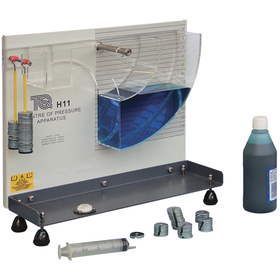
Hydrostatic pressure experimental apparatus

Hydrostatic pressure experimental apparatus

We will conduct experiments on the total water pressure acting on the flat and curved surfaces of a transparent plastic container with a quarter-circle shape supported by a fulcrum, as well as its points of action. We will fill the entire container or part of it with water and measure the forces exerted by the liquid, comparing them to theoretical values.

  • others
  • Experimental Equipment

Added to bookmarks

Bookmarks list

Bookmark has been removed

Bookmarks list

You can't add any more bookmarks

By registering as a member, you can increase the number of bookmarks you can save and organize them with labels.

Free membership registration

Pipe pressure loss experimental device

Pipe pressure loss experimental device

We will conduct experiments on the pressure loss of various piping used in residential central heating systems. There are straight pipes, bent pipes, and two pathways with valves and expansion and contraction mechanisms, and we will close the valve of one pathway to conduct individual experiments. The experiments will require an H1F hydraulic bench (sold separately) for water supply and flow measurement.

  • others
  • Experimental Equipment

Added to bookmarks

Bookmarks list

Bookmark has been removed

Bookmarks list

You can't add any more bookmarks

By registering as a member, you can increase the number of bookmarks you can save and organize them with labels.

Free membership registration

Pelton turbine experimental apparatus

Pelton turbine experimental apparatus

This is a water wheel that uses the impact of water ejected from a nozzle as rotational force, consisting of an 80mm runner, an ejection nozzle, a friction load device (spring scale type), and an inflow pressure gauge. Experiments will be conducted while varying the ejected water volume and load. The device will be placed on a hydraulic bench (sold separately) for the experiments.

  • others
  • Experimental Equipment

Added to bookmarks

Bookmarks list

Bookmark has been removed

Bookmarks list

You can't add any more bookmarks

By registering as a member, you can increase the number of bookmarks you can save and organize them with labels.

Free membership registration

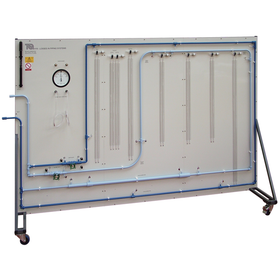
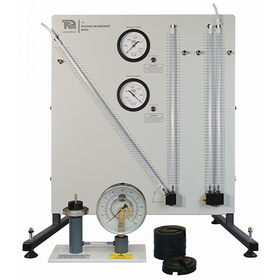
Pressure measurement experimental device

Pressure measurement experimental device

This is an experimental device for comparing and verifying differences in pressure measurement methods. The manometer setup, consisting of a vertical manometer, an inclined manometer, a pressure gauge, and a vacuum pressure gauge, will conduct comparisons of each measurement value and characteristic experiments. Additionally, a specially designed Bourdon tube pressure gauge allows for observation of the movement within the instrument's tube, and characteristic experiments will be conducted during pressurization and depressurization using weights. Each gauge and manometer has a pressure socket, and it comes with a T-joint and tube for conducting pressurization and vacuum experiments using a syringe.

  • others
  • Experimental Equipment

Added to bookmarks

Bookmarks list

Bookmark has been removed

Bookmarks list

You can't add any more bookmarks

By registering as a member, you can increase the number of bookmarks you can save and organize them with labels.

Free membership registration

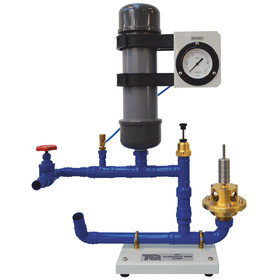
Water hammer pump experimental device

Water hammer pump experimental device

It is a pump that takes in water from a high position and transports it to an even higher position, known as a water hammer or water impact pump. It consists of a drainage valve, air tank, pressure gauge, flow control valve, and elevated water tank set, and is used for experiments in combination with the H1F hydraulic bench (sold separately) and others.

  • others
  • Experimental Equipment

Added to bookmarks

Bookmarks list

Bookmark has been removed

Bookmarks list

You can't add any more bookmarks

By registering as a member, you can increase the number of bookmarks you can save and organize them with labels.

Free membership registration

Energy loss experimental device for piping

Piping energy loss experimental device

A compact tabletop experimental device that compares the energy losses of three types of bent pipes, sudden expansion, and contraction pipes, consisting of a multi-tube manometer and a flow control valve. The experiment requires an H1F hydraulic bench (sold separately) for water supply and flow measurement.

  • Analysis and prediction system
  • Experimental Equipment

Added to bookmarks

Bookmarks list

Bookmark has been removed

Bookmarks list

You can't add any more bookmarks

By registering as a member, you can increase the number of bookmarks you can save and organize them with labels.

Free membership registration

Reynolds number and transition flow experimental apparatus

Reynolds number and transition flow experimental apparatus

We will demonstrate the transition from laminar flow to turbulent flow and compare the critical Reynolds number in transitional flow with theoretical values. The setup consists of a glass head tank and glass tubes, an ink tank, and an injector, allowing us to observe the behavior of the flow using dye while adjusting the flow rate with a drainage valve located at the bottom of the apparatus. We will experiment to see what happens when the flow changes from laminar to turbulent. Additionally, experiments can be conducted using an optional heater module (sold separately) to vary the water temperature and viscosity.

  • Analysis and prediction system
  • Experimental Equipment

Added to bookmarks

Bookmarks list

Bookmark has been removed

Bookmarks list

You can't add any more bookmarks

By registering as a member, you can increase the number of bookmarks you can save and organize them with labels.

Free membership registration

Water Hammer (Hydraulic Shock) Experimental Device

Water Hammer (Hydraulic Shock) Experimental Device

This is an experimental device for understanding the significance of water hammer and cavitation that occur in pumps and hydraulic turbine systems. It consists of a 61-meter long coiled copper pipe, a solenoid valve, pressure sensors and Bourdon tube pressure gauges, a floating flow meter, a flow control valve, and a bypass valve. Water is supplied to a copper pipe with an inner diameter of 12.7 mm, and the flow rate inside the pipe is adjusted using the flow meter and bypass valve. The control box has a solenoid valve operation switch and a BNC terminal for pressure measurement, which can be connected to an oscilloscope (sold separately) to observe the behavior.

  • Analysis and prediction system
  • Experimental Equipment

Added to bookmarks

Bookmarks list

Bookmark has been removed

Bookmarks list

You can't add any more bookmarks

By registering as a member, you can increase the number of bookmarks you can save and organize them with labels.

Free membership registration

Series and parallel pump experimental apparatus (constant speed)

Series and parallel pump experimental apparatus (constant speed)

We will experiment with the operation characteristics of two centrifugal pumps in series and parallel operation, or the performance of a single pump. The equipment consists of electric motors (constant speed) that drive each pump individually, a transparent acrylic water storage tank and valves, and a floating flow meter, with pressure gauges placed at the pump inlet and outlet. The impeller part of each pump is designed with a transparent cover for observation, and cavitation demonstrations can also be conducted. *There is also a PC data collection system type available with an experimental setup similar to H52. H53V Series and Parallel Pump Experimental Equipment (Variable Speed) H53V allows for variable speed control of the pump motor, displaying rotational speed (rpm), torque (N.m), power (W), pressure (bar), flow rate (L/s), and temperature digitally. Additionally, the accompanying software enables real-time data collection and analysis on a PC (sold separately).

  • Analysis and prediction system
  • Experimental Equipment

Added to bookmarks

Bookmarks list

Bookmark has been removed

Bookmarks list

You can't add any more bookmarks

By registering as a member, you can increase the number of bookmarks you can save and organize them with labels.

Free membership registration

Cavitation experiment apparatus

Cavitation experiment apparatus

This is a device for efficiently experimenting with the causes and phenomena of cavitation generated by pumps and turbines. The device consists of a water tank, an electric pump, a flow control valve, a flow meter, a pressure gauge upstream of the Venturi tube and a pressure gauge at the throat, and a Venturi tube (with a transparent window). It allows for easy observation of the occurrence of cavitation while adjusting the flow rate, helping to understand how cavitation begins based on the theory calculated from the temperature, density, and pressure of the water and experimental results.

  • Analysis and prediction system
  • Experimental Equipment

Added to bookmarks

Bookmarks list

Bookmark has been removed

Bookmarks list

You can't add any more bookmarks

By registering as a member, you can increase the number of bookmarks you can save and organize them with labels.

Free membership registration

Aerodynamics experimental apparatus

Aerodynamics experimental apparatus

This is a small wind tunnel experimental device with a test section of 100x50mm. It has a very compact design, allowing for easy movement and storage when not in use. It can be used in a wide range of experiments in combination with auxiliary equipment for demonstrations in lectures, practical training in laboratories, and student research projects. The air discharged from the blower flows into the test section through the rear duct, upper chamber, honeycomb, and converging section. The wind speed is derived using Bernoulli's theorem from the pressure in the test section and the chamber. This device has eight types of experimental setups available for separate purchase, ranging from AF11 to AF18, which can be easily attached to AF10. Each experimental setup can be purchased individually, and you are encouraged to consider configurations that meet your needs.

  • Analysis and prediction system
  • Experimental Equipment

Added to bookmarks

Bookmarks list

Bookmark has been removed

Bookmarks list

You can't add any more bookmarks

By registering as a member, you can increase the number of bookmarks you can save and organize them with labels.

Free membership registration

Series and parallel pump experimental apparatus (variable speed)

Series and parallel pump experimental apparatus (variable speed)

This is a compact tabletop experimental device for testing the operation characteristics of two centrifugal pumps in series and parallel operation, or a single pump. The device consists of electric motors (variable speed) that drive each pump individually, a transparent acrylic water storage tank and valves (for each pump inlet and outlet), pressure sensors (for each pump inlet and outlet), and a flow sensor (for the drainage outlet). The impeller part of each pump is designed with a transparent cover for observation, allowing for demonstrations of cavitation. The included control box allows for variable adjustment of motor speed and digitally displays rotation speed (rpm), torque (N.m), output (W), pressure (bar), flow rate (L/s), and temperature. Additionally, the included data acquisition software VDAS can collect and analyze various data in real-time on a PC (sold separately). *There is also an analog type of experimental device similar to the H53V. H52 Series and Parallel Pump Experimental Device (Constant Speed) The H52 has a constant speed pump motor and is composed of an analog pressure gauge and a float-type flow meter.

  • Analysis and prediction system
  • Experimental Equipment

Added to bookmarks

Bookmarks list

Bookmark has been removed

Bookmarks list

You can't add any more bookmarks

By registering as a member, you can increase the number of bookmarks you can save and organize them with labels.

Free membership registration

Seiki experimental apparatus

Seiki experimental device

It is a small water channel made of reinforced plastic, which allows for the installation of different weirs to control the flow and measure and analyze the flow rate. The device is installed on a hydraulic bench H1F (sold separately) to supply water. It comes with a rectangular weir, two types of V-shaped weirs, and a height gauge. For the experiment, a hydraulic bench H1F (sold separately) for water supply and flow measurement is required.

  • Analysis and prediction system
  • Experimental Equipment

Added to bookmarks

Bookmarks list

Bookmark has been removed

Bookmarks list

You can't add any more bookmarks

By registering as a member, you can increase the number of bookmarks you can save and organize them with labels.

Free membership registration

Orifice flow experimental apparatus

Orifice flow experimental apparatus

The analysis of the flow through the orifice will be conducted as a function of cross-sectional area, flow velocity, and flow rate. It consists of a cylindrical glass tank and an orifice, allowing observation of the water head situation through the orifice, and the measurement of the water head and its range of the jet flow using an integral pitot tube. An aluminum orifice set (6 types) is included. A H1F hydraulic bench (sold separately) is required for water supply and flow measurement for the experiment.

  • Analysis and prediction system
  • Experimental Equipment

Added to bookmarks

Bookmarks list

Bookmark has been removed

Bookmarks list

You can't add any more bookmarks

By registering as a member, you can increase the number of bookmarks you can save and organize them with labels.

Free membership registration

Vortex flow experimental device

Eddy current testing device

A transparent container that creates various types of vortices, generating natural and forced vortices, and measuring their shapes and movements. The device consists of a transparent container with a diameter of 380 mm that rotates with a variable speed motor, a removable perforated transparent container with a diameter of 286 mm, and a traversing pitot tube and depth gauge. Experiments will be conducted with the natural vortex flow using the perforated transparent container attached, and with the forced vortex flow after removing it.

  • Analysis and prediction system
  • Experimental Equipment

Added to bookmarks

Bookmarks list

Bookmark has been removed

Bookmarks list

You can't add any more bookmarks

By registering as a member, you can increase the number of bookmarks you can save and organize them with labels.

Free membership registration

Supersonic wind tunnel experimental device

Supersonic wind tunnel experimental device

Compressed air is rapidly blown from an optional (sold separately) large-capacity compressor and tank into the downstream of the experimental area. The air that passes through the straightening and contraction sections of the wind tunnel supplies stable flows at subsonic, Mach 1.4, and Mach 1.8 to the experimental area. The air that has passed through the experimental area mixes again with the blown air and recirculates. Excess air is discharged from the exhaust filter. The experimental area, measuring 100mm x 25mm, comes with three types of interchangeable liners for subsonic, Mach 1.4, and Mach 1.8. The included model is mounted in the center of the observation window, and experiments are conducted while changing the angle. The pressure at 25 locations in the experimental area is displayed in real-time digitally in four groups, and two Bourdon tube pressure gauges show the pressure from the compressor (sold separately) and the supply pressure to the wind tunnel. *The operating time (approximately 10 to 20 seconds) varies depending on the capacity of the compressed air tank, etc.

  • Analysis and prediction system
  • Experimental Equipment

Added to bookmarks

Bookmarks list

Bookmark has been removed

Bookmarks list

You can't add any more bookmarks

By registering as a member, you can increase the number of bookmarks you can save and organize them with labels.

Free membership registration

Solar panel experimental device

Solar panel experimental device

This is an experimental device for learning about the performance and usage of solar panels and energy storage systems, which are forms of renewable energy. It consists of a solar panel mounted on a lightweight frame with casters, which can be adjusted for angle, a solar radiation meter, a solar panel unit made up of batteries, a control unit that includes a charge controller, and an electrical load unit. The control unit digitally displays the solar panel voltage and current output, battery voltage and current output (when charging), voltage and current output to the electrical load unit, and solar radiation (W/m²). The electrical load device includes four filament lamps and a variable electrical load device (3-50Ω), as well as a 100W inverter for external output. Experiments using batteries with low capacity help investigate charge and discharge cycles. By using the optional (sold separately) data automatic collection system VDAS-B, various data can be collected in real-time to a PC (sold separately) and the experimental results can be analyzed.

  • Analysis and prediction system
  • Experimental Equipment

Added to bookmarks

Bookmarks list

Bookmark has been removed

Bookmarks list

You can't add any more bookmarks

By registering as a member, you can increase the number of bookmarks you can save and organize them with labels.

Free membership registration

Solar heat collection experimental device

Solar thermal collection experimental device

The device mounted on a movable cart understands the principles, advantages, and limitations of collecting solar energy. The device consists of a highly polished stainless steel parabolic reflector, a copper cylindrical energy collector, a turntable, and a display unit. By adjusting the horizontal and vertical positions of the reflector, solar energy can be gathered into the energy collector, and four types of collectors of different sizes allow for experiments at various concentration ratios. Additionally, a removable transparent cover enables the comparison of collector characteristics with and without shielding. A pyranometer is installed on the reflector support to measure the amount of solar radiation energy, and the display unit digitally shows the collector temperature, ambient temperature, and solar radiation amount. By using the optional (sold separately) data automatic collection system VDAS-B, various data can be collected in real-time to a PC (sold separately), and experimental results can be analyzed.

  • Analysis and prediction system
  • Experimental Equipment

Added to bookmarks

Bookmarks list

Bookmark has been removed

Bookmarks list

You can't add any more bookmarks

By registering as a member, you can increase the number of bookmarks you can save and organize them with labels.

Free membership registration

Solar collector experimental device

Solar collector experimental device

We will conduct measurement experiments on solar thermal efficiency and heat loss regarding the use of renewable and environmentally friendly energy sources. Similar to devices used for residential heating or swimming pools, it consists of pipes arranged on a plate, a transparent acrylic cover, a portable frame with an angle adjustment mechanism, a mixing pump, a pressure relief valve, and a control unit. The back of the plate is treated with insulation to reduce heat loss. Cold water supplied from sources such as water mains passes through a flow meter and valve, is heated by the solar collector, and enters the pump. The hot water discharged from the pump mixes with the supplied cold water and heads back to the solar collector. The pressure relief valve operates based on the water supply pressure, releasing hot water to limit internal pressure. The control unit digitally displays the cold water flow rate, solar radiation, cold water temperature, inlet/outlet temperatures of the solar collector, and ambient temperature, clarifying the energy efficiency and heat loss of the solar collector. By using the optional (sold separately) data automatic collection system VDAS-B, various data can be collected in real-time to a PC (sold separately), allowing for the analysis of experimental results.

  • Analysis and prediction system
  • Experimental Equipment

Added to bookmarks

Bookmarks list

Bookmark has been removed

Bookmarks list

You can't add any more bookmarks

By registering as a member, you can increase the number of bookmarks you can save and organize them with labels.

Free membership registration

Cooling tower experimental apparatus

Cooling tower experimental apparatus

This is a tabletop experimental device for an open cooling tower (counterflow type) that cools the cooling water of building air conditioning and heating equipment. Temperature-controlled hot water is sprayed from the top of the cooling tower and is cooled by air while passing through the packing material before returning to the water tank. The orifice at the intake measures the air volume, and the air sent by a variable-speed fan is discharged from the bottom to the top of the cooling tower (counterflow). The measurement values from each sensor (temperature/humidity/flow/pressure) are digitally displayed on the control panel, and data can be collected and automatically calculated using the accompanying software on a PC (sold separately). The device comes with one standard cooling tower that is transparent, allowing for observation of the internal conditions. Additionally, a wide range of experiments can be conducted using four optional cooling towers available for separate purchase.

  • Analysis and prediction system
  • Experimental Equipment

Added to bookmarks

Bookmarks list

Bookmark has been removed

Bookmarks list

You can't add any more bookmarks

By registering as a member, you can increase the number of bookmarks you can save and organize them with labels.

Free membership registration

HVAC-R Experimental Equipment

HVAC-R Experimental Equipment

The air conditioning systems widely used in various industries, as well as for improving living standards, not only maintain comfort in daily life but also refer to the control of industrial process environments. The EC1550V is a device equipped with an HVAC-R air conditioning system that demonstrates the thermodynamic processes of heating and humidifying, cooling, and refrigeration within ducts. The portable experimental device, using R134a as the refrigerant and equipped with movable casters, draws air from the intake grille on the left side of the duct, passing through a manual opening and closing damper, a variable speed axial fan, a primary heater, a steam humidifier, a heat exchanger (water-cooled), a water sprayer, a mist eliminator, and a secondary heater, before being discharged from the exhaust grille on the right side of the duct. It digitally displays the temperature and humidity for each air conditioning process, the air velocity at one location within the duct, the refrigerant pressure (high and low), temperature, refrigerant flow rate, and the power consumption of the compressor. The chilled water tank, temperature-controlled by the refrigeration system, sends chilled water to the heat exchanger in the duct via a variable speed pump, and the inlet and outlet temperatures and flow rates of the heat exchanger are displayed digitally. The primary and secondary heaters, controlled by PID, can be compared in performance with different power inputs.

  • Analysis and prediction system
  • Experimental Equipment

Added to bookmarks

Bookmarks list

Bookmark has been removed

Bookmarks list

You can't add any more bookmarks

By registering as a member, you can increase the number of bookmarks you can save and organize them with labels.

Free membership registration

TD360 Heat Exchange Experiment Device

Heat exchange experimental apparatus

This is a tabletop experimental device that demonstrates heat transfer (overall heat transfer) between adjacent fluids and verifies the effects of flow rate and temperature difference. The heat exchange experimental device TD360 offers four types of heat exchangers: double-tube, plate, multi-tube cylindrical, and tank jacket (coil) type, with experimental items available as options (sold separately). One of these can be attached to the device for experimentation. The system consists of a hot water system and a cooling system, along with a flow control valve and flow meter, with temperatures and flow rates displayed digitally. The hot water system is composed of a tank with a PID-controlled heater, a pump, and a water level gauge, ensuring stable temperature and flow. The digital display shows the inlet and outlet temperatures of hot and cold water, the temperature of the thermocouples integrated into the heat exchanger (sold separately), and the flow rates of hot and cold water, allowing experiments to be conducted without a PC (sold separately). The four types of heat exchangers (sold separately) have the same heat transfer area (0.02 m²) and wall thickness (1 mm), making it easy to compare each exchanger.

  • Analysis and prediction system
  • Experimental Equipment

Added to bookmarks

Bookmarks list

Bookmark has been removed

Bookmarks list

You can't add any more bookmarks

By registering as a member, you can increase the number of bookmarks you can save and organize them with labels.

Free membership registration